
Happy Accidents
Nov 19th 2024
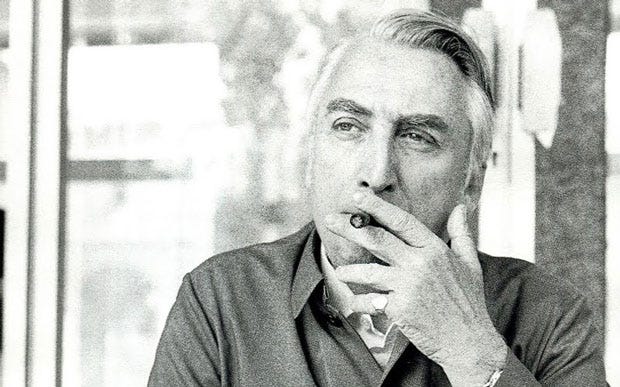
What’s this song about, then, Lloyd?
Well, actually, and without wanting to be an ass, I reject the question.
I’m in the ‘The Death of the Author’ camp. I think that’s we established at this juncture. I suppose I was lucky to be studying literature in Glasgow in my early 20’s, when the French Postmodernists were fashionable. I hated English at school. “What is the message? What is the poet telling you?” I don’t care. Honestly, if a writer has a message and the reader doesn’t get it, what kind of writer is that? Rotten, I’d say.
I loved Barthes. “To give a text an Author is to impose a limit on that text, to furnish it with a final signified, to close the writing.”
If all that if all you care about is the intent of the author, then you restrict the work to a single understanding.
Great art engages the listener, the reader, the viewer. The full value of the work is not revealed at the first listen. As Wilde put it - “If one cannot enjoy reading a book over and over again, there is no use in reading it at all.”
<You may have noticed, that I’m not really using my paragraph breaks ‘properly’. That’s because this isn’t printed. Reading from a screen is different. Different rules. Maybe no rules. Also, I have almost zero grammatical training.>
Back to the business at hand.
To go into a little more detail let’s look at what Clement Greenberg wrote in Avant-Garde and Kitsch (1939). I paraphrase - “the ultimate values which the cultivated spectator derives from the work are derived at a second remove, as the result of reflection upon the immediate impression left by the plastic values. It is only then that the recognizable, the miraculous and the sympathetic enter. They are not immediately or externally present in the work, but must be projected into it by the spectator sensitive enough to react sufficiently to the plastic values. They belong to the reflected effect. In kitsch, on the other hand, the reflected effect has already been included in the work, ready for the spectator’s unreflective enjoyment. Where the great artist paints cause, the the kitsch artist paints effect, providing him with a short cut to the pleasure of art that detours what is necessarily difficult in genuine art. Kitsch is synthetic art.”
You can sense Greenberg’s Marxism in his certainty, can’t you?
Still, if all we accept from Greenberg’s argument is that the reflective effect exists, I think it does, then can’t we then say that as no two spectators, no two listeners are identical (not yet, anyway) therefore there is no single understanding to be had from a painting, or a song. In fact there are an infinite number.
I like this way of thinking of it -
Writers write similes but they don’t write metaphors.
The reader, the listener FINDS the metaphor.
Sure, the writer may have expected this, but the metaphor is not in the text - it’s in the interaction between the text and reader. Between the song and the listener.
How did this thinking impact me as a songwriter?
Well, it’s almost all good news.
Your understanding is necessarily correct.
I don’t need to know what my song’s meaning is. Or why I’m motivated to write it. I only need to know when it seems complete, and that it then meets my standards of beauty and elegance. Years later I may hear a song and think - Oh, that’s what I must have been on my mind…
I love this quote from David Byrne, he said recently (2010’s) - “I can't really hype my own record, or begin to tell what the songs "mean," or why I wrote them. Those things aren't known to me often until at least a year later, when the whole thing is behind me and I can listen to it as if it's someone else's record.”
Flexibility in a lyric becomes a huge plus. Leaving a song without a definite conclusion allows listeners more freedom to deduce their own. Or not.
Scenarios become more attractive than linear plots.
And finally, for now, anyway - if I ever actually have a story to tell, I had better tell it beautifully, and with depth to the lyric if I want anyone to listen more than once.
Why then, I am I recycling this essay snippet from more than a decade ago, today?
Because I found a couple of examples of HAPPY ACCIDENTS is a song of mine, this week. And I thought it might be nice share these, and then to compile other examples of lyrics which were even more flexible than even I realised, when writing them.
The Over Under
There’s nothing to see
There’s no way of knowing
If we’re coming or going
There’s no way to know
We walk through the door
Are we in, are we out now?
Do we twist, do we shout, now?
There’s no way to know
Your guess, I guess
Is as good as mine
We could pool together
And be half right all of the time
My guess, I guess
It’s all, it’s all the same to me
I’ll just throw this out there
If you might care to tag along
Now that I’m no longer chasing certainty
What’s the over
What’s the over under?
We’ve nowhere to be
We need to get going
The old ways of knowing
There’s no way to know
We drive through the night
To be there in the morning
To be where in the morning?
There’s no need to know
And Mama Bear says
“Papa Bear,
Are you lying there
all afternoon?”
Your guess, I guess
Is as good as mine
We could pool together
And be half right all of the time
My guess, I guess
It’s all, it’s all the same to me
I’ll just throw this out there
If you might care to tag along
What’s the over
What’s the over under?
<From Guesswork, 2019>
Both of these are examples of the limitations imposed by lyric sheets.
I’ve always hated them. If there’s one thing that contributes the most to the closing of the writing of a song, it’s the lyric sheet.
Here’s what I wrote -
And Mama Bear says
“Papa Bear,
Are you lying there
all afternoon?”
Singing it this week I realised that if there really has to be a lyric sheet, then it should read -
And Mama Bear says
Papa Bear
Are you lying there
all afternoon?
Then it could be either Mama Bear, or Papa Bear speaking. Much better, right?
Also
We drive through the night
To be there in the morning
To be where in the morning?
There’s no need to know
Could be
We drive through the night
To be there in the morning
To beware in the morning?
There’s no need to know
That’s it. That’s all for today.
More soon.
Should there be footnotes?
Engaging read, and I very much support the main thesis. But I respectfully refute the statement that lyric sheets close the meaning of a song. My argument is that, to a non-native speaker, a written lyric is actually the entry door to all the possible meanings of a song. The author can of course play with punctuation, or remove it all for that matter, but the chosen words, and the way they are arranged in the form of idioms, hint at meanings that natives pick up instantly while non-natives might very easily miss, leading to a poorer experience. It's like the training wheels when learning how to ride a bike - the first few times they are critical, and then off you go.
After years of being taught to explore the writer’s intention when studying for their GCSEs, my poor A-level students have to accept that what the author/writer/poet means is largely irrelevant. I blame Freud. But Barthes is on my hit list, too.